- Home
- Data Science and MLOps Professional Certificate
Data Science and MLOps Professional Certificate
100% Placement Assistance
Industry-led Expert Instructors
Live/Online Training Sessions
Globally Recognized Curriculum
Partnered with :

Please confirm your details

Learning Format

Live Classes

Placement Support

LMS Support
How does an Data Science & MLOps Professional Certificate?
Program Details
Key Takeaways
Holistic Mastery of the AI Lifecycle
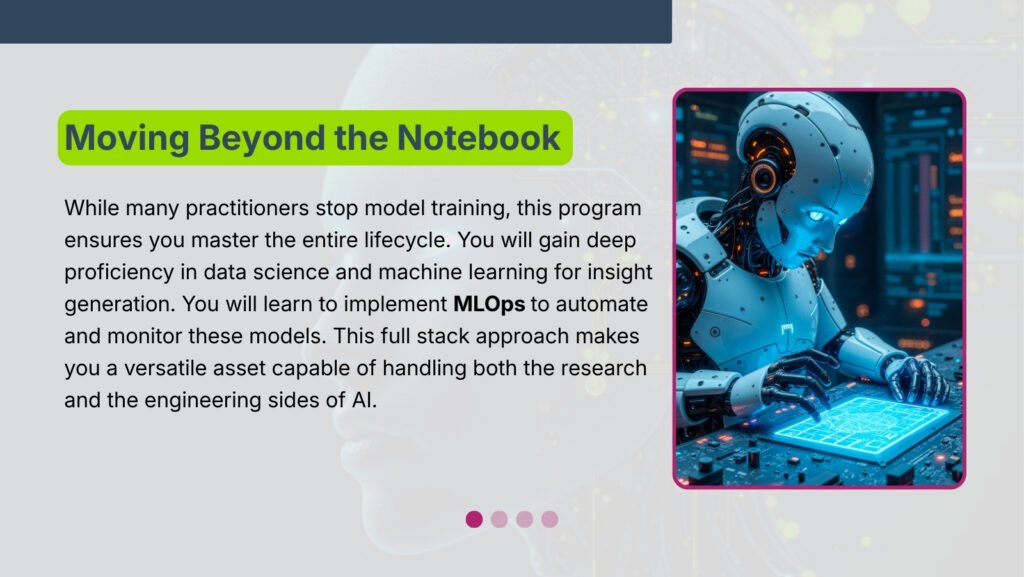
The Data Science and MLOps Professional Certificate provides a unified path from raw data to production-ready models. You will master Python for Data Science and Python Machine Learning to extract insights and build predictive engines. By merging Data science and Machine Learning with operational rigor, you ensure that your projects move beyond local environments and into scalable, real-world applications.
Operational Excellence with ML DevOps
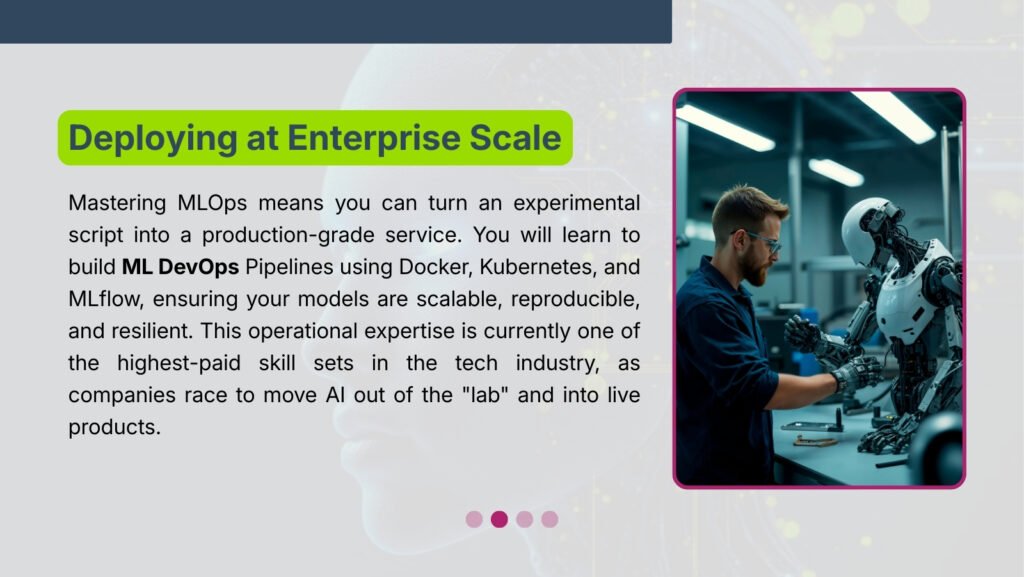
A core pillar of the program is mastering the ML DevOps Pipeline. You will learn DevOps for ML and ML in DevOps strategies to automate the deployment, monitoring, and retraining of models. This focus on ML Ops and ML for DevOps ensures that you can manage "model drift" and maintain high performance in enterprise ecosystems using tools like Docker, Kubernetes, and MLflow.
Advanced Neural Architectures & Gen AI
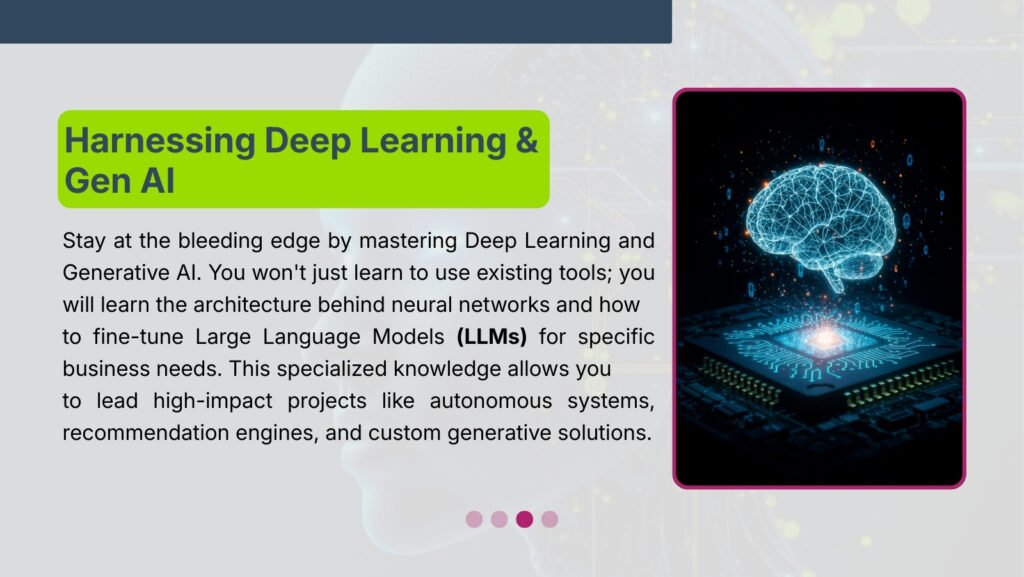
The curriculum dives deep into the future of tech with Deep Learning AI and Generative AI. You will use PyTorch and TensorFlow for Deep Learning tasks like image recognition and NLP. Furthermore, you will explore Gen AI architectures, learn how to fine-tune foundation models, and integrate them into existing ML DevOps frameworks for cutting-edge product development.
Industry-Standard Credentials and Projects
Through the IBM Data Science integration, you gain access to global best practices and professional-grade tools. The program features 22+ projects where you apply Machine Learning to solve industry-specific challenges. Graduating these credentials validates your expertise in Data Science and production-scale engineering, making you a highly competitive candidate for senior technical roles.
Professional Certification for Data Science and MLOps
Once you complete the data science and MLOps professional certificate course, you will get a globally recognized certification from Win in Life Academy in collaboration with IBM.
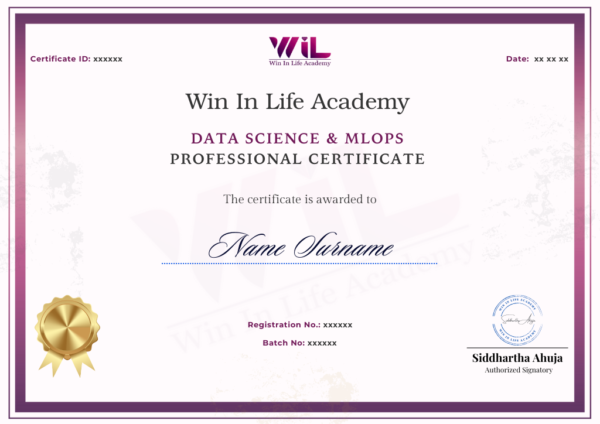
Globally Recognised Certification
Note: Secure your professional certificate in data science and MLOps course. For this certification, you must successfully complete the training from Win in Life Academy. Once you complete this program, you will be also eligible to get a certificate from IBM.
Tools to be Covered in Data Science and MLOps Professional Certificate




Disclaimer :
All tools, software, and datasets in this professional certificate in data science and MLOps course is for educational and training purposes only. We provide these resources to demonstrate data science and MLOps concepts in a guided environment. Many tools are trial or limited versions and carry inherent risks such as system instability or data loss. Win in Life Academy offers no warranties regarding the performance, accuracy, or reliability of these platforms beyond their use for classroom demonstration.
Our Distinctive Approach
We offer exceptional learning experience in Data Science & MLOps Professional Certificate by blending industry-aligned curriculum, cutting-edge tools, and mentorship from seasoned professionals in data science and machine learning operations.
Applied Learning & Real-World Projects
Engage in hands-on learning through guided IBM labs, live data science simulations, and real-world projects that tackle industry challenges in machine learning, MLOps, and AI model deployment. Work on projects that focus on data engineering, automation of workflows, and building scalable AI solutions across multi-cloud environments.
Mentorship from Industry Experts
Learn directly from experienced data scientists, MLOps engineers, and machine learning specialists who share invaluable insights into the latest industry trends and technologies. Receive personalized mentorship on applying tools like TensorFlow, Kubernetes, Apache Spark, and IBM Watson to design, deploy, and scale AI systems effectively.
Career Growth & Marketing Pathways
Gain access to comprehensive career mentorship, placement assistance, and expert guidance to help you transition into high-demand roles like Data Scientist, MLOps Engineer, Machine Learning Engineer, or Cloud Data Engineer. Take advantage of networking opportunities and industry connections to secure impactful positions across global industries.
Please confirm your details
Win in Life Academy’s Data Science and MLOps Professional Certificate
Best Data Science and MLOps Professional Certificate course by experienced faculty and industry leaders in the form of pre-recorded videos, projects, assignments, and live interactive sessions.





Frequently Asked Questions (FAQs)
This data science and MLOps professional certificate is an end-to-end program that bridges the gap between building models and deploying them in production. Unlike standard courses, it integrates specialized IBM modules and 22+ live industry projects, ensuring you master both the statistical foundations of data science and the operational rigor of MLOps for enterprise-scale AI.
It is designed for aspiring data professionals and software engineers who want to move beyond local Jupyter notebooks. If you aim to become a “full-stack” data expert capable of managing the entire lifecycle – from data ingestion to automated model monitoring. This data science and MLOps professional certificate you need.
MLOps (Machine Learning Operations) ensures that models are reliable, scalable, and maintainable in real-world environments. Without it, 80% of AI projects fail to reach production. Mastering this discipline allows you to automate the transition from a prototype to a live service, managing versioning and performance in real-time.
Win in Life Academy’s MLOps training is cloud-agnostic, covering major platforms like AWs SageMaker, Azure ML, and Google Vertex AI. You will learn to use tools like Docker and Kubernetes to containerize your models, ensuring they run consistently whether they are deployed on premises or in a multi-cloud architecture.
The Data Science track at Win in Life Academy focuses on three core pillars: mathematical rigor (statistics and linear algebra), technical proficiency (Python and SQL), and business intuition. You will learn to transform raw, messy data into actionable insights that solve complex problems in FinTech, Healthcare, E–commerce.
Win in Life Academy’s Data Science and MLOps modules are constantly refined by industry experts. It includes emerging techniques like Causal inference and advanced Feature Engineering. By working on 22+ industry-backed projects, you ensure your skills are not just theoretical but aligned with the current demands of the global tech market.
The Machine Learning modules cover a spectrum from classical regression and classification to ensemble methods like XGBoost and Random Forests. We emphasize “Algorithmic Thinking,” teaching you how to select the right model based on data constraints and business objectives rather than just applying a one-size-fits-all approach.
In this course, Machine Learning evaluation goes beyond simple accuracy. You will learn to use precision-recall curves, F1-scores, and ROC-AUC analysis, while also considering operational metrics like latency and computational cost to ensure your models are efficient in a live environment.
For deep learning, we provide hands-on training in both TensorFlow and PyTorch. These industry-standard frameworks allow you to build complex architectures like Convolutional Neural Networks (CNNs) for image recognition and Recruitment Neural Networks (RNNs) for sequential data analysis.
While deep learning is an advanced topic, Win in Life Academy’s curriculum provides the necessary bridge from basic neural networks to complex architectures. We recommend completing the machine learning fundamentals first to ensure you understand the underlying optimization techniques like backpropagation and gradient descent.
Generative AI requires a specialized operational approach called GenAIOps. You will learn how to fine-tune Large Language Models (LLMs) and deploy them using RAG (Retrieval-Augmented Generation) architectures, ensuring your generative applications are grounded in factual private organizational data.
You will work on Generative AI projects such as automated code generators, personalized marketing content engines, and intelligent chatbots. These projects focus on moving beyond “prompting” to building full-scale applications that use foundation models to solve specific enterprises challenges.
Python for data science is the industry standard due to its readability and its massive ecosystem of libraries like Pandas and NumPy. It allows you to perform complex data manipulation and statistical analysis with minimal code, making it the perfect tools for both rapid prototyping and production-level engineering.
Yes, a significant portion of Python for data science is dedicated to data wrangling. You will learn to handle missing values, normalize datasets, and automate the ETL (Extract, Transform, Load) Processes that are crucial for any successful analytical project.
While traditional DevOps manage code, ML Ops must manage code, data, and models simultaneously. Since data is constantly changing (leading to “model drift”), ML Ops requires continuous monitoring and automated retraining cycles that are not typically found in standard software development.
In our ML Ops labs, you will use tools like MLflow and DVC (Data Version Control). These tools allow you to track every experiment, including the exact dataset and hyperparameters used, so you can reproduce results or roll back to a previous model version instantly if performance drops.
Our Python Machine Learning modules focus heavily on Scikit-learn for traditional algorithms and libraries like Matplotlib and Seaborn for visualization. Mastering these tools ensures you can build, visualize, and tune models efficiently within a single, unified Python environment.
You will learn techniques like vectorization and hyperparameter tuning (using GridSearchCV) to ensure your Python Machine Learning code is as efficient as possible. This is critical for high-frequency applications like fraud detection or real-time recommendation engines.
Deep Learning AI has revolutionized fields like medical imaging and autonomous driving. In this course, you will learn to build CNN architectures that can identify patterns in images with higher accuracy than human observers, opening career paths in specialized high-tech sectors.
Training deep learning AI requires significant graphics processing unit power. Win in Life Academy provides access to cloud-based environments with high-performance computer resources, so you can train large-scale neural networks without needing expensive hardware at home.
Think of data science and machine learning as the “insight” and the “engine.” Data science focuses on asking the right questions and preparing the data, while Machine Learning provides predictions to answer those questions at scale. This program teaches you to master both sides of the coin.
Yes. Our Data Science and Machine Learning path starts with foundational logic and Python basics. Many of our successful alumni come from finance, marketing, and healthcare backgrounds, leveraging their domain expertise alongside their new technical skills to find niche leadership roles.
The IBM data science modules provide you with access to professional-grade tools like IBM Watson Studio and SPSS. By completing these integrated segments, you earn digital badges from IBM that are globally recognized by recruiters, instantly boosting the credibility of your professional profile.
Yes, the IBM data science guided labs are woven into the core curriculum. They serve as practical checkpoints where you apply what you’ve learned to real IBM datasets, ensuring you meet the high standards expected by global tech leaders.
Not at all. While ChatGPT is a famous example, models, and the Orchestration of multiple AI agents. You will learn to build your own generative systems rather than just being a “user” of existing ones.
Win in Life Academy’s Gen AI curriculum includes advanced modules on prompt engineering and RAG. You will learn to ground your AI’s responses in specific, verified data sources, which is the primary industry method for eliminating hallucinations and ensuring enterprise-level reliability.
ML DevOps focuses on creating a “seamless loop” between model development and deployment. By automating the CI/CD (Continuous Integration/Continuous Deployment) pipelines for machine learning, you ensure that new models can be tested and pushed to the end-user without manual errors or downtime.
In ML DevOps, we implement “Prometheus and Grafana” dashboards to track metrics like data drift and prediction latency. This allows engineers to be alerted immediately if a model’s performance starts to degrade, enabling proactive maintenance instead of reactive fixing.
Using ML for DevOps involves applying predictive models to IT operations (AIOps). You will learn how to build models that predict server failures or detect security anomalies, allowing DevOps teams to move from scheduled maintenance to predictive, automated self-healing systems.
Yes, you will learn how to build automated pipelines where the ML for DevOps model itself is continuously updated based on system logs, ensuring your monitoring tools stay as smart as the infrastructure they are protecting.
DevOps for ML requires specialized infrastructure, such as GPU clusters and large-scale data scientists have the computer they need when they need it, without overspending on cloud costs.
We focus on Kubernetes and Kubeflow, which are the industry standards for DevOps for ML. These tools allow you to manage complex workflows and ensure that your machine learning services are “resilient,” meaning they can automatically restart or scale up during high traffic.
A ML DevOps pipeline at Win in Life Academy includes Data ingestion -> Automated Preprocessing -> Model Training -> Validation -> Deployment -> Monitoring. You will learn to build this entire sequence as a single, automated “flow” that can be triggered whenever your data changes.
Security is integrated at every stage. You will learn to use “DevSecOps” principles to scan your containers for vulnerabilities and ensure that sensitive training data is encrypted and handled according to global privacy standards like GDPR.
By using ML in DevOps, organizations can automate the “testing” phase of the release cycle. Machine learning models can predict which code changes are most likely to cause bugs, allowing teams to focus their manual reviews on high-risk areas and speed up the overall deployment process.
Automated feedback loops are the heart of ML in DevOps. You will learn how to feed real-user data back into your development cycle, allowing your models to learn from their own performance and improve automatically with every new release.